


Portuguese for Travel: Essential Language for Your Trip
You do not need advanced Portuguese to have a much easier, more enjoyable trip. A relatively small amount of practical language can help you order food, understand prices, find your way around, check into accommodation, shop, socialize, and ask for help when something does not go as planned.
The key is to learn the Portuguese you are actually likely to use. That means prioritizing high-frequency questions, common replies, numbers, directions, and everyday vocabulary rather than trying to cover the language broadly before departure. It also means paying attention to destination. A traveler in Brazil will hear different pronunciation, vocabulary, and informal expressions from someone spending two weeks in Portugal.
That destination-specific focus is useful more generally when learning Portuguese as an English speaker. You do not need to know everything before you start communicating, but the language you practice should match the situations and people you expect to encounter.
Table of Contents
- Portuguese for Travel: What You Actually Need to Know
- Essential Portuguese Greetings and Polite Expressions
- Getting Around in Portuguese
- Eating Out in Brazil and Portugal: Useful Portuguese for Restaurants
- Shopping in Portuguese
- Portuguese for Hotels and Accommodation
- Socializing in Portuguese While Traveling
- Asking for Help in Portuguese
- How to Practice Portuguese Before Your Trip
- Prepare for Your Trip With Personalized Portuguese Lessons
- Frequently Asked Questions About Portuguese for Travel
→Sign Up Now: Free Trial Portuguese Lesson With a Native Teacher!←
Portuguese for Travel: What You Actually Need to Know
For most trips, practical Portuguese matters more than grammatical range. You are unlikely to need a long discussion about verb moods before you need to recognize a price, understand a direction, or explain that you have a reservation.
A useful travel vocabulary should therefore cover:
- Greetings and politeness: Enough to open and close interactions naturally.
- Numbers, prices, dates, and times: Essential for transport, restaurants, shopping, bookings, and schedules.
- Basic questions: Particularly where, when, how much, which, and whether something is available.
- Understanding simple replies: Asking a question is only useful if you can recognize the likely answer.
- Directions and transport: Stations, stops, tickets, departure times, and basic location words.
- Food, accommodation, and shopping: The everyday situations where travelers often need to communicate directly.
- Emergency and problem-solving language: Expressions for asking for help, explaining that you do not understand, or saying that something has gone wrong.
Travelers also benefit from learning phrases as complete chunks rather than building every sentence from scratch. Knowing Quanto custa? (“How much does it cost?”), for example, is immediately more useful in a shop than memorizing quanto and custar separately and trying to assemble the question under pressure.
Essential Portuguese Greetings and Polite Expressions
Greetings are simple, but they shape the tone of an interaction. In both Brazil and Portugal, opening with a greeting before asking for something usually sounds warmer and more natural than going directly into a request.
| Portuguese | English |
| Olá | Hello |
| Bom dia | Good morning |
| Boa tarde | Good afternoon |
| Boa noite | Good evening / Good night |
| Por favor | Please |
| Obrigado / Obrigada | Thank you |
| Desculpe | Sorry / Excuse me |
| Com licença | Excuse me |
| Não entendi | I didn’t understand |
| Fala inglês? | Do you speak English? |
Obrigado and obrigada depend on the gender of the speaker rather than the person being thanked. A male speaker normally says obrigado, while a female speaker says obrigada.
Com licença is particularly useful when moving past someone, interrupting politely, or trying to get through a crowded space. Desculpe is more appropriate when apologizing or politely attracting someone’s attention.
The exact level of formality can vary. In Brazil, travelers will often hear warm, informal language fairly quickly, especially in relaxed social settings. In Portugal, interactions with strangers can initially sound more reserved or formal, particularly in shops, restaurants, or service encounters. That does not mean people are unfriendly. It simply makes polite greetings and forms of address especially useful.
It is also worth learning how to admit that you have lost the thread of the conversation. Não entendi is often more valuable than pretending to understand, and Pode repetir, por favor? (“Can you repeat that, please?”) can keep the interaction going without immediately switching to English.
Getting Around in Portuguese
Transport is one of the first areas where travelers discover that memorizing a question is only half the task. You also need to understand times, numbers, basic directions, and the vocabulary used locally for different types of transport.
A few useful expressions include:
| Portuguese | English |
| Onde fica a estação? | Where is the station? |
| Onde fica a paragem / o ponto de ônibus? | Where is the bus stop? |
| Quero um bilhete para… | I’d like a ticket to… |
| A que horas sai? | What time does it leave? |
| Este vai para…? | Does this go to…? |
| Quanto custa a passagem / o bilhete? | How much is the ticket? |
| À direita | To the right |
| À esquerda | To the left |
| Em frente | Straight ahead / in front |
| Aqui | Here |
| Ali | There |
When asking directions, listen for location words rather than trying to understand every sentence. If someone gives a long explanation but you recognize direita, esquerda, and em frente, you may already have enough information to follow it.
Taxi and rideshare conversations can be even simpler. Giving the destination and saying Pode me deixar aqui (“You can drop me off here”) may be all you need. Having the address visible on your phone also helps when pronunciation or street names become difficult.
Getting Around in Brazil
In Brazil, a bus is usually an ônibus and a train is a trem. Bus stops are commonly called pontos de ônibus, while metrô is widely used for metro systems.
A traveler might ask:
Onde fica o ponto de ônibus?
“Where is the bus stop?”
or:
Esse ônibus vai para o centro?
“Does this bus go downtown?”
Transport terminology can still vary by city, and large Brazilian cities often have their own systems, ticket cards, and local abbreviations. In places such as São Paulo or Rio de Janeiro, it is useful to learn the names of the transport systems you will actually use rather than relying only on generic vocabulary.
Brazilian Portuguese pronunciation also varies considerably by region. You do not need to imitate every local accent, but hearing destination-specific audio before the trip can make announcements and quick interactions much easier to follow.

Getting Around in Portugal
In Portugal, a bus is normally an autocarro and a train is a comboio. A bus stop is usually a paragem, and bilhete is the standard word you will see for a ticket.
Useful questions include:
Onde fica a paragem do autocarro?
“Where is the bus stop?”
and:
Este comboio vai para Lisboa?
“Does this train go to Lisbon?”
The differences are small enough that speakers will often understand the Brazilian terms, but learning the local version reduces confusion and makes signs, announcements, apps, and conversations easier to process.
Transport is therefore a good example of why the differences between Brazilian and European Portuguese matter in practical travel situations. You do not need two entirely separate vocabularies, but knowing the terms used at your destination makes the language immediately more useful.
Eating Out in Brazil and Portugal: Useful Portuguese for Restaurants
Eating out is one of the situations where a little Portuguese goes a long way. You do not need to understand every item on the menu, but being able to ask for a table, order confidently, explain a dietary restriction, and request the bill can make the experience much smoother.
A few phrases cover most situations:
| Portuguese | English |
| Uma mesa para dois, por favor. | A table for two, please. |
| Posso ver o menu / cardápio? | Can I see the menu? |
| Queria… | I would like… |
| O que leva este prato? | What is in this dish? |
| Sou vegetariano / vegetariana. | I’m vegetarian. |
| Tenho alergia a… | I’m allergic to… |
| Sem… por favor. | Without… please. |
| A conta, por favor. | The bill, please. |
| Este não foi o meu pedido. | This wasn’t my order. |
Vocabulary differs between Brazil and Portugal in small but noticeable ways. In Brazil, a menu is commonly a cardápio, while menu is widely understood in both countries. Juice is normally suco in Brazil and sumo in Portugal. Those differences are easy to learn and are worth knowing because they appear constantly in cafés, restaurants, and supermarkets.
The food itself will also shape what you hear. In Brazil, travelers may encounter dishes such as feijoada, pão de queijo, moqueca, or coxinha, while menus in Portugal commonly feature bacalhau, caldo verde, pastéis de bacalhau, and grilled fish. Learning a few local food names before you arrive makes menus much easier to navigate.
If you have an allergy or dietary restriction, learn the relevant sentence rather than relying on individual ingredient names. Tenho alergia a amendoim (“I’m allergic to peanuts”) or Não como carne (“I don’t eat meat”) communicates the important information much more clearly.
It is also useful to listen for follow-up questions. A server may ask about drinks, side dishes, cooking preferences, or whether you want anything else. Even if you do not understand every word, recognizing a few likely terms can keep the conversation moving.
Shopping in Portuguese
Shopping usually involves a predictable set of questions, so it is an ideal situation for using basic Portuguese confidently. Prices, sizes, colors, quantities, and payment methods matter more than complex grammar.
Useful expressions include:
| Portuguese | English |
| Quanto custa? | How much does it cost? |
| Tem em outro tamanho? | Do you have it in another size? |
| Tem em outra cor? | Do you have it in another color? |
| Posso experimentar? | Can I try it on? |
| Aceita cartão? | Do you accept cards? |
| Vou pagar em dinheiro. | I’ll pay in cash. |
| Pode dar-me / me dar o recibo? | Can you give me the receipt? |
| Tem desconto? | Is there a discount? |
Numbers deserve particular attention because they come up constantly. If someone tells you vinte e oito euros or cento e cinquenta reais, you need to recognize the amount quickly enough to respond.
Mini-exchanges are useful practice:
Quanto custa esta camisa?
“How much is this shirt?”
Trinta euros.
“Thirty euros.”
Or:
Tem este em tamanho médio?
“Do you have this in medium?”
In Brazil, you will hear prices in reais; in Portugal, in euros. Payment habits may also differ by country and business, but asking Aceita cartão? is a simple way to clarify whether card payment is available.
The goal is not to memorize every possible retail phrase. You mainly need enough language to ask about price, availability, size, quantity, and payment, then understand the most likely replies.
Portuguese for Hotels and Accommodation
Accommodation language is usually straightforward because the situations are repetitive: checking in, confirming a booking, asking about facilities, and reporting a problem.
A few phrases can cover most of what travelers need:
| Portuguese | English |
| Tenho uma reserva em nome de… | I have a reservation under the name… |
| A que horas é o check-out? | What time is checkout? |
| O café da manhã / pequeno-almoço está incluído? | Is breakfast included? |
| Qual é a senha do Wi-Fi? | What is the Wi-Fi password? |
| Posso deixar a bagagem aqui? | Can I leave my luggage here? |
| Há um problema com o quarto. | There is a problem with the room. |
| Preciso de outra toalha. | I need another towel. |
| Pode dar-me / me dar outra chave? | Can you give me another key? |
Breakfast vocabulary is a good example of the Brazil-Portugal divide. In Brazil, breakfast is café da manhã. In Portugal, it is pequeno-almoço. Both refer to the same meal, but using the local term makes signs, booking information, and hotel conversations easier to understand.
If something is wrong, simple language is usually best. O ar-condicionado não funciona (“The air conditioning isn’t working”) or Não há água quente (“There is no hot water”) communicates the problem more effectively than trying to construct a complicated explanation.
Keep your reservation details available on your phone as well. Showing a booking confirmation can fill gaps when names, dates, or room types are difficult to communicate.
Socializing in Portuguese While Traveling
Portuguese becomes much more rewarding when you can use it for more than transactions. Even a few simple personal questions can turn an interaction in a café, hostel, tour, or bar into an actual conversation.
Useful starters include:
Meu nome é…
“My name is…”
Sou dos Estados Unidos / Canadá / Inglaterra.
“I’m from the United States / Canada / England.”
Onde você mora?
“Where do you live?”
Estou viajando por duas semanas.
“I’m traveling for two weeks.”
Gosto muito daqui.
“I really like it here.”
Quer tomar alguma coisa?
“Would you like to have a drink?”
If you want to accept an invitation, Claro! (“Of course!”) or Sim, vamos! (“Yes, let’s go!”) works well. If you want to decline politely, Obrigado, mas hoje não posso (“Thanks, but I can’t today”) is simple and clear.
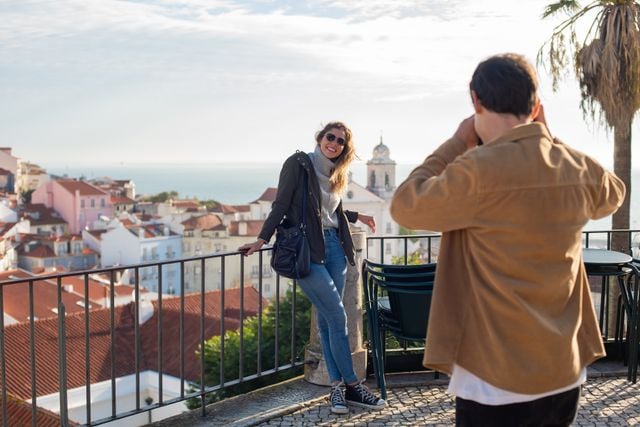
A tourist having her picture taken in Lisbon
Informal Portuguese can differ noticeably between Brazil and Portugal. Brazilian conversation may use forms such as cara, galera, or beleza?, while Portuguese speakers may use expressions such as pá, malta, or fixe. You do not need to adopt local slang immediately, but recognizing a few common expressions can make spontaneous conversations much easier to follow.
Forms of address differ too. Brazil often uses você widely in everyday conversation, while European Portuguese may use names, titles, or other structures instead of você in many situations. Listening to how local speakers address one another is often the easiest way to judge what sounds natural.
Asking for Help in Portuguese
Knowing how to repair a conversation is often more useful than memorizing another fifty nouns. Travelers regularly encounter situations where they understand only part of what someone has said, and having a few phrases ready can prevent the interaction from ending immediately.
Useful expressions include:
| Portuguese | English |
| Pode me ajudar? | Can you help me? |
| Não entendi. | I didn’t understand. |
| Pode repetir, por favor? | Can you repeat that, please? |
| Pode falar mais devagar? | Can you speak more slowly? |
| Onde fica…? | Where is…? |
| Estou perdido / perdida. | I’m lost. |
| Preciso de um médico. | I need a doctor. |
| Onde fica a farmácia? | Where is the pharmacy? |
| Onde fica a delegacia / esquadra? | Where is the police station? |
The last example illustrates another regional difference: delegacia is common in Brazil, while esquadra is used in Portugal.
If you miss part of an answer, resist the urge to switch languages immediately. Asking Pode repetir? or Pode falar mais devagar? gives the other person a chance to adjust. Many travelers find they understand much more once the sentence is repeated slowly or phrased differently.
How to Practice Portuguese Before Your Trip
The most useful pre-travel practice should resemble what you will actually need once you arrive. Instead of trying to cover as much Portuguese as possible, rehearse a smaller number of high-frequency situations until the language feels familiar.
A practical routine might include:
- Listen to the accent you will hear: Choose Brazilian Portuguese if you are going to Brazil and European Portuguese if you are traveling to Portugal. Getting used to local rhythm is just as important as learning vocabulary.
- Rehearse common situations aloud: Practice checking into a hotel, ordering a meal, asking for directions, and buying a ticket rather than only reading the phrases silently.
- Save essential expressions on your phone: Keep a short note with allergies, emergency phrases, addresses, and important questions you may need quickly.
- Practice numbers and prices: Dates, departure times, room numbers, totals, and change are easy to overlook until you actually need them.
- Practice likely answers too: If you learn to ask A que horas sai o trem?, also train yourself to understand times such as às oito e meia or às dez e quinze.
Listening deserves particular attention because travelers often discover that asking a question is easier than understanding the reply. Becoming familiar with Portuguese pronunciation before you travel helps you recognize words you already know when they appear in fast, connected speech.
Prepare for Your Trip With Personalized Portuguese Lessons
Even a short Portuguese course can make a noticeable difference before a trip when the lessons are built around where you are going and what you expect to do there.
Someone traveling through Brazil might focus on Brazilian pronunciation, transport vocabulary, restaurants, social interactions, and common questions for hotels or shops. A traveler preparing for Portugal may need more exposure to European Portuguese listening, local terms such as comboio and autocarro, and the speech rhythm they will hear in everyday interactions.
That destination-specific focus is part of a Portuguese course built around your travel goals. Rather than spending limited preparation time on topics you may never use, lessons can concentrate on realistic scenarios, speaking, listening, and the vocabulary most relevant to your itinerary.
Listen & Learn offers personalized Portuguese lessons online and face to face, with schedules that can be adapted around your departure date and courses focused on either Brazilian or European Portuguese.
So, why arrive knowing only “Olá”? Contact Listen & Learn today and prepare for your trip with personalized Portuguese lessons built around your destination and the situations you are most likely to face.
→Sign Up Now: Free Trial Portuguese Lesson With a Native Teacher!←
Frequently Asked Questions About Portuguese for Travel
-
How Much Portuguese Do I Need for a Trip?
You do not need advanced Portuguese for most trips. Around 20–50 hours of focused study can be enough to build useful travel basics, including greetings, numbers, directions, restaurant language, transport vocabulary, shopping, and simple expressions for asking for help. With regular listening and speaking practice, that can be enough to handle many common situations without relying entirely on English.
-
Is English Widely Spoken in Brazil and Portugal?
English is spoken in many tourist areas, hotels, and international businesses, especially in major cities, but you should not assume everyone will speak it. Basic Portuguese is particularly useful in smaller towns, local restaurants, shops, transport situations, and conversations outside heavily touristed areas.
-
Should I Learn Brazilian or European Portuguese for Travel?
Learn the variety spoken at your destination. Brazilian Portuguese is the obvious choice for Brazil, while European Portuguese will prepare you better for Portugal. The language is mutually intelligible, but local pronunciation and everyday vocabulary can differ noticeably.
-
How Long Before My Trip Should I Start Learning Portuguese?
Starting a few months before departure gives you time to build useful listening and speaking skills, but even a few weeks of focused study can help. If time is short, concentrate on the situations you are most likely to encounter rather than trying to cover Portuguese broadly.
-
What Portuguese Phrases Should I Learn First?
Start with a few high-value expressions you can use almost anywhere: Olá (“Hello”), Por favor (“Please”), Obrigado/Obrigada (“Thank you”), Não entendi (“I didn’t understand”), Pode repetir, por favor? (“Can you repeat that, please?”), Onde fica…? (“Where is…?”), and Quanto custa? (“How much is it?”). Add simple travel phrases such as Queria… (“I would like…”), A conta, por favor (“The bill, please”), and Este vai para…? (“Does this go to…?”).